I’ve Created a Logo Using AI.
Can You Turn it
Into Professional Artwork?
5 min read
It’s a question we’re being asked more and more.
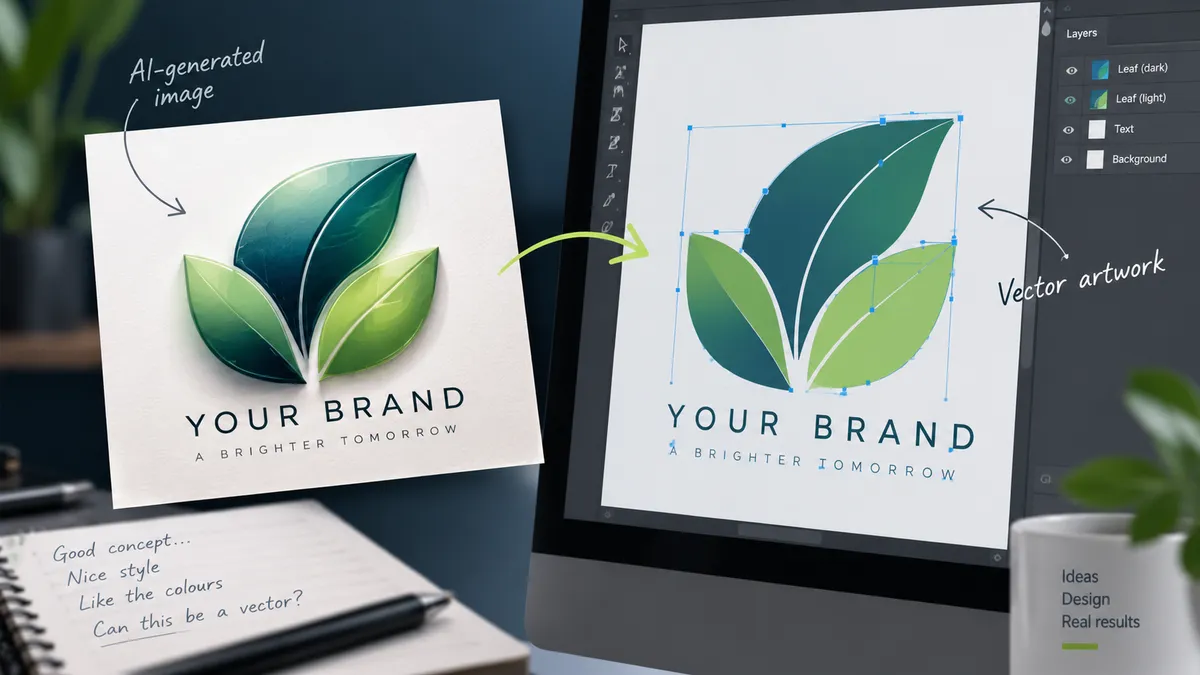
“Can you just recreate this as a vector?”
The answer is that, in some circumstances, we can reproduce an AI-generated image as vector artwork.
But there is an important distinction between recreating an image as a vector and developing a logo for your business.
AI can be a really useful tool for exploring ideas. It can help you experiment with colours, styles and concepts and work out what you do and don't like before speaking to a designer.
There is more to consider when an AI-generated image moves from being an idea or visual reference to becoming the identity of a business, particularly around its limitations, practical use and longer-term suitability.
A Vector Isn't Simply a Better-Quality Image
Recreating an AI-generated logo as vector artwork can make it much more practical to use across different applications and sizes. However, what can be recreated successfully will depend on the original image.
A properly constructed vector logo is made from editable shapes and typography, allowing it to be reproduced accurately at virtually any size. AI-generated logos, on the other hand, are often created as image files rather than editable vector artwork. They can contain gradients, shadows, textures, highlights, tiny details and complex shapes that look impressive on screen but can be difficult to reproduce accurately as vector artwork.
While software can automatically trace an image, we can also manually recreate artwork to produce a cleaner and more controlled result. Even then, fine detail, textures, lighting effects, gradients and complex or inconsistent shapes may need to be simplified or interpreted during the process.
This means the finished vector may differ from the original image and, in some cases, it may simply not be possible to recreate the design closely enough for the result to look the same. The quality and complexity of the original image will determine what can realistically be achieved.
Vectorising the artwork also doesn't address any of the wider questions about the design itself. It gives you a different type of artwork file but the design decisions behind it remain the same.
Looking Good on Screen is Only the Beginning
An AI-generated logo may have been created to answer one immediate question:
"Does this look good?"
For a business, a logo has to do much more.
Will it still be clear on a business card?
Can it be embroidered onto clothing?
Can it be cut accurately from vinyl?
What happens when it is printed in one colour?
Will it still be recognisable as a small social media profile image or website favicon?
Could it work on large signage or exhibition graphics?
A logo that looks fantastic as a large, detailed image on a screen can become almost unrecognisable when it's reproduced at a much smaller size.
When a logo is developed by a graphic designer, these applications are considered from the beginning, with alternative configurations, simplified versions or different colour options created where needed.
Recreating an AI-generated image as a vector makes the artwork scalable but it doesn't guarantee the design will work effectively in every application.
Does the Logo Actually Represent Your Business?
This is where the conversation becomes much bigger than the artwork file because a logo isn't simply about creating something that looks good.
Before we develop an identity, we want to understand the business behind it.
What do you do and what makes you different?
Who are your customers?
Who do you want to attract in the future?
What perception do you want to create?
Where will your identity be seen?
What does the business stand for and where is it going?
Those answers influence the creative decisions we make, from typography and colour through to shape, proportions and overall style.
Your customers don't necessarily need to understand the story behind every line or shape within your logo but there should be thinking behind the decisions that created it.
That's the difference between creating something that looks appropriate for an industry and developing something that feels appropriate for a particular business.
Is it Distinctive Enough to be Yours?
One of the challenges with AI-generated logos is that they can draw on familiar ideas associated with a particular industry.
Ask for a financial services logo and you may get arrows, graphs, initials and dark blues. Ask for an environmentally focused company and you may see greens, leaves and globes. Ask for an engineering business and gears, hexagons and metallic effects can quickly appear.
These aren't necessarily bad ideas. Visual familiarity can help communicate what a business does.
But familiar and distinctive aren't the same thing.
If businesses within the same sector are using similar prompts, drawing on the same visual conventions and following the same current styles, there is a risk that their identities begin to feel very similar too.
Your logo has an important job to do. It needs to help people recognise you.
That's why identity development looks beyond familiar visual conventions and considers how an idea can become more individual and relevant to the business it represents.
What About Copyright?
Copyright and AI is a developing area and it isn't as simple as saying that an AI-generated image has no copyright.
Under current UK law, copyright protection can apply to computer-generated and AI-assisted work in certain circumstances. Exactly what protection applies and who owns the relevant rights can depend on how the image was created.
An AI-generated image appearing on screen doesn't automatically tell us whether everything within it is original or whether protected elements of existing work may have been reproduced within the output.
Turning that image into vector artwork doesn't remove that uncertainty. Recreating the logo changes the format of the artwork but it doesn't establish its originality or confirm that the design, or individual elements within it, are free from third-party rights.
Where there is any uncertainty about where an image has come from or its similarity to existing artwork, it may be more appropriate to develop the idea further rather than reproduce it.
What if you Want to Trade Mark Your Logo?
An AI-generated logo can potentially be registered as a trade mark, just like any other logo. What matters is whether it meets the requirements for registration.
Part of that is how distinctive the logo is and whether it is too similar to trade marks that already exist. This can be particularly relevant where a design uses imagery or ideas that are common within an industry, as there may be less to distinguish it from other identities.
The UK Intellectual Property Office recommends searching for similar trade marks before applying, which can help identify anything that could affect an application.
If registering your logo is important to your business, specialist advice can also help you understand what protection may be available and what you should consider before applying.
Will it Still Feel Right in Five or Ten Years?
AI can be very effective at reflecting visual styles and trends that feel current now, which can be useful when exploring ideas. The same consideration applies to any logo, however it is created: will it still feel appropriate in five or ten years?
A good identity doesn't need to ignore trends completely and it certainly doesn't need to look conservative. The important thing is that the creative direction isn't dependent on what's fashionable at that particular moment.
Businesses evolve. They introduce new products and services, move into different markets, attract larger customers and appear in places the owner may never have anticipated when the company started.
A strong identity should have enough flexibility to grow with the business rather than hold it back.
So, What are Your Options if You've Created a Logo Using AI?
An AI-generated logo can be a useful starting point and, in some cases, the result may give you exactly the visual direction you were looking for.
If you want to use the design as it is, it may be possible to recreate it as vector artwork, making it more practical to use across different applications. It's important to remember, though, that vectorising the artwork doesn't confirm its originality or establish what rights may apply to it.
Alternatively, you may decide that what you've generated is better used as a starting point. The colours, style, typography or concept can all provide useful insight into what you like and help inform the development of the identity from there.
What matters is understanding the difference between reproducing an image you already have and developing the idea further, so you can decide which is appropriate for your business.
AI gives businesses another way to explore creative ideas. Understanding both its possibilities and its limitations helps you make an informed decision about what happens next.
Ready to Elevate Your Brand? Let's Chat.
Whether you need ongoing design support or a full brand refresh, we’ll take care of the visuals
so you can focus on growing your business.
Contact us
Lime Design Studio -
Graphic Design & Branding
Office 3a, Knights Farm, Newton Road, Rushden, Northamptonshire NN10 0SX
Email: [email protected]


Lime Design Studio providing graphic design and branding in Rushden, Northampton, Milton Keynes, Leicester, Kettering and across the UK.
Copyright 2026 Lime Design Studio Ltd.